Archive for the ‘General Recycling’ Category

E-Waste Collection Programs on the Rise

Thursday, May 27th, 2010

It has taken some time, but the public has begun to realize how dangerous the e-waste epidemic is. Take a second to think about it. Technology is advancing every day with new electronics being released to replace the past ones, even if they are just a year or two old.

The problem is  that recycling efforts can’t keep up with the rate technology is evolving. When consumers get that new electronic, where does the old one go? More often that not it goes right in the trash, which will eventually make its way to the landfill.

It was just recent that the e-waste problem started to grab the attention of government officials. Faced with the dilemma of solving this environmental issue, solutions had to be made to prevent this from further spreading. Manufacturers are now being held more responsible for their products as well.

It’s a finger pointing issue where no one wants to accept the responsibility of solving the e-waste pollution situation. Luckily, there have been some changes in that attitude surfacing the past few months. Some states have set standards that manufactures have to abide by when it comes to recycling their old products. And surprisingly most manufacturers are complying; working with consumers to set up e-waste recycling programs.

Even retail giants such as Target and Best Buy have set up recycling programs that accommodate e-waste. Private and public recyclers have begun adapting e-waste into their programs. Non-profits such as Recycling for Charities have established programs to help fight e-waste. Municipalities are forming programs for their citizens to recycle their old electronics. The fight against e-waste is finally making some noise and if programs like these continue we and Mother Nature will be thankful in the future.

For information on e-waste programs in your state check out E-Cycling Central. Also, our Recycling for Charities program helps fight the e-waste problem while supporting non-profits. If you have handheld electronics that need to be recycled you can donate the items to one of our affiliated charities.

Success Dressed in Green for Earth Day Celebration

Monday, April 19th, 2010

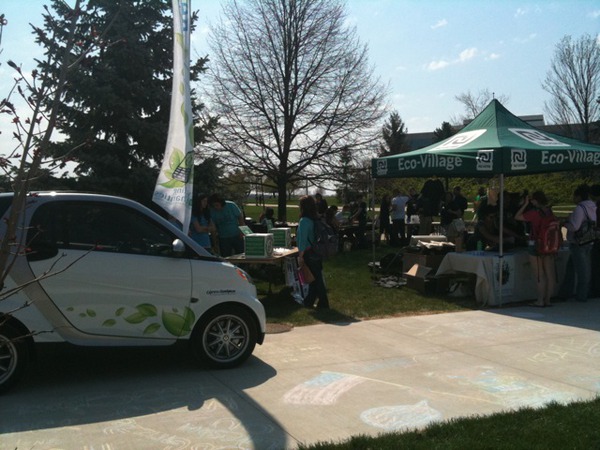
Recycling for Charities could not have asked for a better day to celebrate the 40th Anniversary of Earth Day. The sun was shining down on their eco-friendly Smart Car; the newest hits provided by 98.7 AMP Radio kept everything upbeat and the donations pouring in. The campus of Oakland University was glowing green thanks to students, staff and local community members.

Interested overseers hung out during set up and engaged in conversation about various green facts and how to help maintain our Earth with volunteers from Recycling for Charities (RFC), Sustaining Our Planet Earth (SOPE), Reverb and The Salvation Army. From 11:30 a.m. until 1:30 p.m. there were several tables stationed outside of the Oakland Center that provided food, key chains, pins, green facts, seeded pots,  and activities. Students, staff, and members of the community had the opportunity to donate their broken/old phones, iPods, cameras, electronics and clothing. All donors were entered in a drawing for eco-friendly prizes. Recycling for Charities raffled off a Kodak Digital Camera and a Digital Photo Frame. The winner of RFC’s raffle will be announced and contacted sometime next week.

The Earth Day Celebration helped RFC keep 50 tons of e-waste out of landfills. Also, the raised funds were donated to the Michigan Hospice. The Salvation Army walked away with bags upon bags that will help clothe our community and Reverb promoted their Campus Consciousness Tour encouraging students to actively go green. Green gardens will be growing this spring too as the biodegradable pots provided by Bethel Farms and planted with seeds from Siegers were a big hit! The teamwork from all organizations combined to create an exciting, fun and educational environment.

If you thought you missed out on the fun, think again! We will be in Downtown Royal Oak this Sunday, April 25, from 12 p.m. until 4 p.m. continuing the celebration of Earth Day with Recycle Royal Oak. Bring your e-waste!

You can also stay updated about our green initiatives and events by following us on Facebook and Twitter.

Gardening Goes Green with Biodegradable Pots

Thursday, April 8th, 2010

Trying to find a way to make your garden even greener this season? Then it is time to ditch those plastic planting pots that usually end up in landfills anyway and start thinking biodegradable!

No Glues. No Binders. Nothing Artificial. This is how DOT Pots™ describes its unique gardening products. For them, what the pots are made of is just as important as what they aren’t made of. The biodegradable pots are created solely from all natural wood fibers, 80% spruce fibers and 20% peat moss, which are harmless to the environment. The pots, available through Bethel Organics, are the first and only 100% organic, biodegradable plantable pots in the world!

We know biodegradable is a fancy word that is being thrown around a lot in the ‘green’ world today, but what does it actually mean for your garden? Before it has dissolved into the earth, the walls of the pot retain water so that less water is needed. The plant roots, which grow even stronger in the DOT Pots, then easily grow right through the bottom of the pot when they have developed enough. For those of us who have trouble with transplanting, these DOT Pots will be your saving grace. The entire pot is placed in the ground once the plant is ready to upgrade to a bigger amount of soil, so you won’t lose nearly as many plants to transplant shock.

The EPA has reported that only 3.9 percent of plastics are recycled each year, which means our landfills are being filled with tons of waste that could be avoided. And this waste is anything but good for our environment. Most plastics, especially those made many years ago, contain chemicals that are released when the plastic is put in a landfill or littered. These chemicals can eventually seep into groundwater and become a health risk to both wildlife and humans. Using biodegradable pots like the DOT Pots helps keep those pesky plastic flower containers from being made, and ultimately from being thrown in landfills.

Stronger plants, environmentally friendly, no clean up necessary, and no waste created. Why wouldn’t you choose DOT Pots for your next garden project? For more information on these pots and to find out where they are sold you can visit DOT Pots or Bethel Organics.

Looking for other ways to go ‘green’? Recycling for Charities keeps tons of e-waste out of landfills each year through recycling, and helps raise funds for non-profit organizations in the process. To learn more, visit our website or follow us here:

Recycling for Charities would like to thank Bethel Organics for their extremely generous donation. The donated DOT Pots will be used as eco-friendly giveaways at our upcoming Earth Day events where RFC hopes to educate the community about the importance of recycling e-waste.

Oakland University Earth Day Celebration

Friday, April 2nd, 2010

It is that time of the year again; time to clean out your dorm room and move back home for the summer. Most likely you have come across something while packing up that you had completely forgotten about. Maybe a cell phone you dropped in a puddle while rushing to class. Or an iPod that’s battery is more drained than you are after finals week. Why not doing something positive with these electronics that you aren’t using anymore?

Recycling for Charities has partnered with the Sustaining Our Planet Earth organization of Oakland University to celebrate the 40th Anniversary of Earth Day. As a non-profit charity, Recycling for Charities (RFC) defends the environment and supports other worthy non-profits through recycling, donating the money raised to over 800 charities nationwide. On April 15 the two organizations hope to prevent nearly 50 TONS of electronic waste, which can leak harmful chemicals, from entering landfills while celebrating the environmentally-friendly holiday at Oakland University’s campus.

From 11:30 a.m. until 1:30 p.m. students, staff, and members of the community will have the opportunity to donate broken and used electronics such as cell phones, iPods, digital cameras, pagers and PDAs. RFC, stationed with their eco-friendly Smart Car at the Oakland Center, will be accepting electronic donations to be recycled. Every donor will receive an entry into a contest to win prizes, such as a Kodak Digital Camera or Digital Photo Frame, simply for donating their used e-waste! If you are planning on being on campus April 15 remember to keep your old electronics with you and head to the Oakland Center where all the fun will be! All funds raised from the recycling of the e-waste collected will benefit the Hospice of Michigan, a charity chosen by SOPE.

Attendees will be able to participate in other ‘green’ Earth Day activities on campus as well provided by Reverb, including organic t-shirt screen printing and seed planting, and can grab an organic bite to eat while listening to a live DJ from a local radio station spin the newest hits. As a part of Reverb’s Campus Consciousness Tour, rapper Drake will also be performing on April 15 at the Meadow Brook Theater.

You can easily receive updates about this event by following Recycling for Charities on Twitter and Facebook, too:

We need YOUR help! Only 10 percent of used or broken cell phones are recycled each year. What is your excuse? Be sure to do your part this Earth Day by helping RFC and SOPE keep 75 tons of e-waste out of our landfills!

Oakland University is located at 2200 N. Squirrel Road, Rochester, Michigan 48309.

Plastic Waste Forms Island of Garbage in Pacific Ocean

Thursday, February 18th, 2010

The Great Eastern Garbage Patch. Have you ever heard of it? Most haven’t. Located at a natural collecting point right in the center of revolving currents called the North Pacific Gyre, the Great Eastern Garbage Patch is a floating island of waste estimated to be twice the size of Texas. That’s right- TEXAS. Somehow this massive garbage heap had shied away from the media for years, but has now been brought to the public’s attention via Captain Charles Moore of the Oceanographic Research Vessel Alguita, who is credited for its discovery.

Thousands of miles from land this garbage patch is littered with debris that many would assume is from people aboard passing ships, but researchers think not. They estimated that 80 percent of the trash is actually due to land dwellers and has eventually found its way over the years to the North Pacific Gyre. This is nothing but bad news considering that there is even more trash riding the currents as you sit and read this now, destined to add to the island’s growth.

A 10 mile-wide fleet of plastic Taco Bell take-out bags.

80,000 Nike running shoes involved in a containership spill in 1990.

Discarded fishing nets and lines that run miles long.

“Nurdles”, or tiny plastic pellets that resemble tapioca and carry high concentrations of deadly chemicals, one hundred billion pounds of which are used each year to make things like CD cases and plastic pipes.
This is just some of what can be found on and near the Great Eastern Garbage Patch, but they all equal this: roughly one million pieces of plastic per square mile across hundreds of miles of the Pacific Ocean. Countless animals in and out of the water have confused these floating plastic objects as food or have gotten tangled or strangled in plastic lines and nets only to lose their lives. According to Marine Biologist David Barnes of the British Antarctic Survey, “Plastic is not just an aesthetic problem. It can actually change entire ecosystems.”

Right now we can only expect the trash to continue invading the ocean. There are bans in place to prevent the dumping of plastics but enforcement on the open ocean is not taken seriously and when accidents occur they do not need to be reported. This means people like Captain Moore, who are trying to stop plastic from taking over our ocean, don’t even have a chance to clean up the debris left by others, even if by accident.

What is ironic is that people value plastics for the same reason plastics are causing so much harm to our oceans: its durability. While manufacturers place the blame of plastic debris on consumers, Captain Moore makes a good point saying that, “there’s no reason why a six-pack ring or a peanut butter jar should have to last for 400 years.” While manufacturers have attempted to perfect biodegradable packaging there is only one company, EarthShell, which has made real progress. The company has already begun work with the National Park Service who uses their biodegradable plates and has even provided many McDonald’s restaurants with their clamshell boxes. The Environmental Cleanup Coalition has also made a huge impact by taking the initiative to collaborate with other organizations who try to come up with ways to safely remove plastic and other pollutants from the ocean.

Recycling for Charities is passionate about helping to eliminate waste in any way possible. While we are limited to recycling electronic waste we have tips to help consumers prevent the growth of this plastic-waste island too. You can buy products with less plastic packaging and therefore decrease your plastic waste. For example, instead of buying pop or soda that has a six-pack ring around them, buy the case in the cardboard box that can later be broken down and recycled. Also, you can practice and promote the proper disposal of plastic items. Recycle your plastic waste when possible and never litter, especially near places like the beach where wildlife can mistake your trash for food. If you do not have the means to donate money to an environmental organization you can always donate your time by helping with a local clean-up at a park or beach. Remember, your small effort can make a big difference.

Follow RFC on Twitter Follow RFC on Facebook
Recycling for Charities Podcasts